
Key Benefits of Game Customer Support Outsourcing

Updated: Aug 11
Key Benefits of Game Customer Support Outsourcing
The game customer service outsourcing market was valued at $2.82 billion in 2025 and is projected to reach $6 billion by 2035 (WiseGuyReport), showing a major shift in how studios approach player support. For growing studios, outsourcing is no longer just a cost-saving option. It is becoming a strategic move to scale support, improve service quality, and meet rising player expectations. Response time directly affects retention: when players wait too long for help with bugs, payments, account issues, or in-game problems, frustration builds, and churn follows. This is why many studios turn to outsourced game customer support for faster responses, 24/7 coverage, multilingual assistance, and a more consistent player experience, capturing the core benefit of game customer support outsourcing in one move.
Key Takeaways
Game customer support outsourcing helps studios scale efficiently: Outsourcing allows studios to handle growing player support demands without carrying the fixed costs of a full in-house team.
24/7 and multilingual support improve player experience: Outsourced teams help studios serve players across time zones and languages, reducing frustration and making global communities feel better supported.
Faster response times can reduce churn: Dedicated support queues, AI-assisted triage, and specialist agents help resolve tickets faster, protecting player satisfaction, retention, and long-term value.
Specialist gaming expertise matters: Gaming-native support teams understand game mechanics, player behavior, live events, bans, payment issues, and community culture better than generic support providers.
Strong onboarding and clear processes set outsourcing up for success: Studios that invest in brand voice guidelines, structured onboarding, security verification, and defined KPIs from day one get the most value as support teams scale.
1. Lower Operational Cost Without Sacrificing Quality
One of the clearest game support outsourcing advantages is cost structure. AllyOps employees receive full benefits, including 13th-month pay, government-mandated contributions, HMO, paid vacation leave, and paid sick leave. The client pays a single flat fee, and AllyOps manages and absorbs those costs as part of that fee. This is what makes the model work: the savings come from avoiding recruitment, onboarding, and infrastructure overhead, not from reduced compensation for the people doing the work. Budget that would otherwise sustain a fixed support department gets freed up for game development, marketing, or live-ops investment, the areas that actually move the needle on growth.
The pricing model has two layers: a dedicated core team that the studio maintains continuously, plus the option to add surge support during spikes like launches, events, or patch cycles. This combination gives studios predictable baseline costs alongside the flexibility to handle demand swings, which is especially valuable for studios whose ticket volume shifts with content drops and patch cycles.
When comparing outsourcing vs. in-house gaming support, the math rarely favors building from scratch unless a studio has the scale to justify full-time, dedicated roles across every shift and language. For most teams, the in-house model carries hidden costs (training time, attrition, management overhead) that outsourcing absorbs as part of the service. Lower game support outsourcing cost does not mean lower quality. It means redirecting fixed spend toward a model that matches real demand while a specialized partner handles execution.

2. 24/7 Player Support Without the Overhead
Gaming communities operate across every time zone, and player frustration does not wait for business hours. Maintaining true 24/7 player support in-house requires multiple shift rotations, complex scheduling, and significant overtime costs, a burden most studios, especially smaller ones, simply cannot sustain on a lean internal team.
Outsourced partners solve this with distributed teams already spread across regions, delivering follow-the-sun support as a standard service rather than a costly add-on. A ticket submitted at 2 a.m. local time gets the same response quality as one submitted at 2 p.m., because the support function is not tied to a single office's working hours.
This matters most for live-service titles. A missed surge during a live event, a patch window gone wrong, or a server issue that hits overnight is a direct churn risk if no one is watching. Round-the-clock game support is not a premium feature in this context. It's operational infrastructure, on par with server uptime or payment processing reliability. Studios that treat gaming support coverage as a baseline requirement, not a luxury, protect player trust during the exact moments when that trust is most fragile: when something has gone wrong, and players need to know someone is listening.
3. Multilingual Support That Meets Players Where They Are
Games regularly find audiences in markets the studio never specifically targeted, and those players expect support in their own language, not a machine-translated FAQ. Multilingual game support is one of the most overlooked advantages of outsourcing because it solves a problem most studios do not realize they have until churn data from a specific region quietly underperforms.
Language gaps do not just create confusion. They signal to the player that they are an afterthought, which directly damages loyalty. A player who cannot get help in their own language is far more likely to disengage quietly than escalate, making the problem invisible until it shows up in retention metrics.
Native-language agents also catch issues English-only teams miss entirely: local payment failures, region-specific platform rules, and cultural context in disputes that change how an issue should be handled. This is why player support languages function as more than a service nicety. They are a market access decision. A studio that can only serve players in one or two languages is functionally limiting its addressable audience, no matter how strong the game itself is. Outsourcing gives studios access to global gaming customer service and localized player support without building separate regional teams from scratch.

4. Improved Response Times That Prevent Churn
Outsourced specialist teams typically run dedicated queue structures, separating payments, account issues, and technical problems, to prevent backlog spillover and reduce the gap between ticket submission and first response. This structural separation is a major factor in better game support response time, since agents are not context-switching between unrelated issue types.
AI-assisted triage routes tickets to the right specialist faster, reducing repeat contacts and improving first-contact resolution. The result is fast player support that resolves issues in one interaction rather than several back-and-forth messages, which matters both for player satisfaction and for the team's actual ticket-resolution throughput.
Slow response does not just frustrate the individual player. It pushes them toward a public outlet. A negative App Store or Steam review costs far more in acquisition damage than the ticket would have cost to resolve quickly. One bad public review can offset weeks of paid acquisition spend. Players who get fast, effective support are more likely to continue spending, while players who wait often disengage from monetization events before their issue is even resolved. Strong ticket resolution time and consistent game support CSAT scores are leading indicators of revenue health, not just service quality.
5. Enhanced Player Retention and Lifetime Value
Support is one of the few touchpoints where a studio can directly recover a player who is already frustrated. Handled well, it turns a near-churned player into a loyal one. This makes player retention game support one of the highest-leverage benefits outsourcing offers, because it converts a cost center into a retention mechanism.
Players who feel heard develop a deeper sense of belonging to a game's community, increasing the likelihood they stay through seasonal cycles, expansions, and live events. That sense of belonging is difficult to manufacture through marketing alone. It is built interaction by interaction, in support tickets and community channels.
Acquiring a new player costs significantly more than retaining an existing one, which means every player saved through quality support is a direct revenue-protection event, not just a service outcome. This is the core link between support quality and gaming customer support LTV: each prevented churn event compounds over a player's remaining lifetime value. Outsourced teams with community management capability, such as Discord moderation and forum health monitoring, also shape the broader community environment, which is consistently one of the biggest predictors of long-term retention in live-service games and a proven way to reduce player churn and build lasting game support player loyalty.
6. Access to Gaming-Native Expertise and Specialist Tools
Generic BPO agents can answer a ticket. Gaming-native support agents understand why the ticket exists. They grasp game mechanics, in-game economies, live-event dynamics, and community culture in ways that show up clearly in every player interaction. When an agent knows the game, players notice the difference immediately.
Correct issue classification matters more than it seems. A ban dispute in a competitive title is a fundamentally different problem from a billing error, and misrouting it wastes time while damaging player trust in the process. This is where game support expertise separates specialized outsourcing partners from generic call-center vendors.
Outsourced gaming specialists also bring access to tools most studios cannot justify building in-house: AI-assisted triage, in-game SDK support integration, sentiment analysis dashboards, and community health monitoring. These AI game support tools are expensive to build and maintain independently, but come bundled as part of a specialist provider's infrastructure. The market for agents who are both gaming-literate and customer-service trained is genuinely thin. Specialist gaming BPO providers give studios immediate access to talent they could not realistically recruit on their own.
7. Scalability for Launches, Live Events, and Seasonal Spikes
Live-service games experience predictable volatility. Event launches, influencer campaigns, patch days, and seasonal promotions can multiply ticket volume overnight in ways an in-house team simply cannot absorb without burning out. Scalable game support is built into the outsourcing model precisely because providers maintain bench capacity for exactly these moments.
Outsourced partners can deploy seasonal or surge agents to meet a spike, adding trained capacity during a launch, live event, or content drop without the lead time it would take to hire and onboard internally. This responsiveness is critical for game launch support, where the first 48 hours often set the tone for community sentiment going forward.
Scaling back down works on a different timeline, and it is worth setting that expectation clearly from the start. Reducing the team once a peak has passed is handled with appropriate notice, in line with the terms agreed at the start of the engagement, rather than happening overnight. A fixed in-house team still carries full headcount and cost during quiet periods, while the surge layer of an outsourced model gives studios a way to manage that cost more deliberately, scaling up quickly when demand calls for it and scaling back down on agreed terms once it passes. Studios that already have a battle-tested outsourced team in place before launch day handle crises faster and with less reputational damage than those scrambling to find help once tickets start flooding in, making live-service player support and LiveOps support scalability a planning decision made well before launch, not a reaction to it.

Strengthening Your Outsourced Game Support Setup
A few areas reward extra attention early in the relationship, and getting them right from the start is what separates outsourcing that feels seamless from outsourcing that feels bolted on.
Maintaining brand voice and tone: Setting aside time early to build a written style guide for support agents keeps your brand identity intact and elevates the player experience, especially for games with a distinct community culture, humor, or narrative style. Pairing that guide with tone-of-voice training during onboarding and regular sample-response reviews in the first 30 days gives agents what they need to sound like the studio, not a generic vendor. Skipping this step is what allows agents to default to generic responses that feel disconnected from the game.
Structured onboarding and product knowledge: Structured onboarding at game launch enables agents to give complete and accurate responses from day one. Planning 4 to 6 weeks of pre-launch onboarding, with access to internal patch notes, developer briefings, known-issue trackers, and community intel, builds the foundation agents need to handle launches, updates, and major in-game events confidently. Without that runway, a new team needs more time to find its footing, particularly during high-pressure moments.
Data security and player privacy: Verifying that a vendor's security policies and certifications genuinely support compliance with GDPR, PCI DSS, COPPA, and any other regulation relevant to your regions and audience is the concrete step that protects both player data and studio reputation. Outsourced support teams often need access to player accounts, payment-related information, and personal data, so studios should request third-party audit documentation, limit access based on role, and define data-handling protocols contractually before engagement begins.
Quality consistency at scale: Setting CSAT targets, response-time SLAs, escalation rules, QA scorecards, and monthly performance reviews from day one keeps response quality steady as an outsourced team grows. This structure is what allows studios to scale support volume without the inconsistent answers or slower resolutions that show up when KPIs and reporting cadences are left undefined. Boutique partners offering dedicated account management also reduce drift here significantly, since clients are not competing for attention the way they would with large, multi-client BPOs.
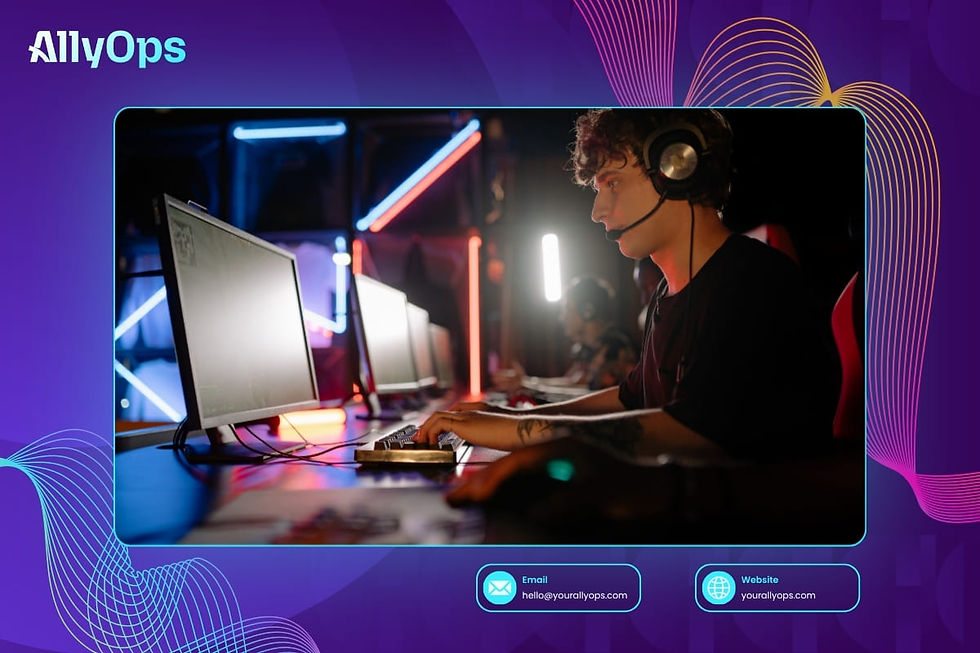
Who Is Game Customer Support Outsourcing Best Suited For?
Understanding who should outsource game support helps studios decide if the model fits their stage and structure.
Indie studios post-launch: Managing a growing ticket queue with a small internal team while trying to ship the next update. Outsourcing provides immediate relief without a headcount commitment.
Mobile gaming companies: High-volume, low-margin environments where cost efficiency is critical, and player expectations for speed are high, making mobile game customer support outsourcing a natural cost-to-quality match.
Live-service and multiplayer games: Any title with ongoing seasons, events, or community dynamics needs support that matches the pace of live-ops — 24/7, scalable, and gaming-literate, which defines effective live-service game support.
Studios expanding into new markets: Entering Asia-Pacific, Latin America, or Europe requires multilingual support capacity that most studios don't have in-house.
Web3 and play-to-earn games: Communities with real financial stakes have elevated support expectations and complex dispute types requiring specialized agent training.
Game Peripherals and Devices: Compatibility with multiple devices and games is critical for the widespread adoption of peripherals. Having a team to catch inquiries and file bug reports is critical to ensuring your audience has reliable hardware for any game.
Why Choose AllyOps for Your Game Customer Support?
AllyOps is a boutique BPO based in Cebu City, Philippines, built for startups and SMEs that need enterprise-quality game support without being deprioritised by a large vendor juggling dozens of accounts.
The core differentiator is simple: AllyOps recruits, vets, onboards, and manages a dedicated team built around the client's specific game, community culture, and KPIs, not a generic shared queue. For gaming clients, that means 24/7 ticket, chat, voice, and in-game support, billing and account dispute handling, content moderation, Discord and community management, and multilingual player support, all under one roof.
The Build Your Own Team model puts the studio in control. The studio defines the scope, rules, and standards, and AllyOps handles execution. The team operates as a seamless extension of the studio itself, not an external vendor running its own playbook, which is the difference between outsourced support that feels bolted on and support that feels native to the game.
Book a free call to find out what a dedicated game support team built around your studio could look like.
FAQs
What is game customer support outsourcing?
Game customer support outsourcing is when a studio hires an external partner to manage player support tasks such as tickets, chat, account issues, billing disputes, moderation, and community support.
Why do studios outsource game customer support?
Studios outsource to reduce operational costs, provide 24/7 coverage, improve response times, access multilingual agents, and scale support during launches, live events, patches, or seasonal traffic spikes.
Is outsourcing game support only for large studios?
No. It can be useful for indie studios, mobile gaming companies, live-service games, studios expanding into new markets, and Web3 or play-to-earn games with complex player support needs.
What are the main risks of outsourcing game support?
The main risks include inconsistent brand voice, limited product knowledge, data security concerns, player privacy issues, and quality drift if KPIs, training, and QA processes are not clearly defined.
How can studios make outsourced game support successful?
Studios should provide detailed onboarding, brand voice guidelines, access to game documentation, clear escalation rules, security protocols, CSAT targets, response-time SLAs, and regular performance reviews.

