
Top 10 Gaming Customer Support Companies to Watch in 2026

Updated: Aug 11
The global gaming market is projected to reach $250+ billion by 2026, and the competition to retain players is fiercer than ever. With over 20,000 games released on Steam alone in 2025, studios that treat customer support as an afterthought are handing their players a reason to leave. Choosing the right gaming customer support partner is now a revenue decision, not just an operations one.
Key takeaways
Gaming customer support is now a retention and revenue driver, not just an operational function, because poor support can directly increase churn and damage player trust.
The best gaming support companies differ by use case: boutique partners like AllyOps fit startups and SMEs (Small and Medium Enterprises), while enterprise BPOs (Business Process Outsourcing) such as Teleperformance and Concentrix suit high-volume global publishers.
Studios should evaluate providers based on gaming expertise, multilingual coverage, AI support tools, scalability, data security, and communication transparency.
A strong gaming support partner should understand player culture, handle launch or LiveOps volume spikes, and provide consistent support across tickets, chat, voice, in-game channels, and community spaces.
AllyOps is positioned as a strong choice for gaming startups and SMEs that need dedicated, client-specific support teams without enterprise-level minimums.
Why Gaming Customer Support Matters More Than You Think
Player support is not a back-office function. It is a retention lever. According to game support essentials, 67% of players consider customer support a crucial factor in their gaming experience, 78% will abandon a game following poor support, and players with positive support experiences show 40–60% higher 90-day retention compared to those with poor or no support. These numbers are not soft metrics. They translate directly to lifetime value, churn costs, and word-of-mouth in communities where player reviews drive purchasing decisions. Poor gaming customer service does not just lose tickets — it loses players permanently, and often publicly. The studios winning at retention today are the ones treating player support as a product function, not a cost centre.
Getting support right starts with choosing the right partner. Here are the 10 best gaming customer support companies to consider in 2026.

10 Best Gaming Customer Support Outsourcing Companies in 2026
1. AllyOps
AllyOps is a boutique BPO based in Cebu City, Philippines, built for startups and SMEs that need enterprise-quality support without being deprioritised by a large BPO. For gaming companies, AllyOps provides 24/7 game support across tickets, chat, voice, in-game channels, and Discord, alongside content moderation and community management. Every team is recruited and trained around the client’s specific game, community culture, and KPIs - not a generic script library. Smaller studios get a real partner, not a ticket number.
Specialization: Game support, content moderation, community management, 24/7 omnichannel support
Notable Strength: Fully dedicated team model with client-specific onboarding. No shared queues, no generic SLAs.
Best For: Boutique gaming BPO for studios that need gaming customer support outsourcing in the Philippines without enterprise minimums

2. Simply Contact
Simply Contact is an outsourced customer service provider with 12+ years of experience. For gaming companies, it delivers dedicated player support teams trained on product specifics, capable of handling complex in-game issues and peak-load situations across voice, chat, email, and social channels. Its AI-augmented support operations use chatbots, agent assist, and smart routing to reduce costs while improving response times and CSAT. Multilingual player support across 30+ languages makes it a strong choice for publishers operating across multiple regions.
Specialization: 24/7 omnichannel support, AI-powered automation, multilingual support in 30+ languages, PCI DSS and ISO-certified data protection
Notable Strength: Performance-driven management with analytics built for high-volume, fast-scaling gaming environments
Best For: European gaming support and publishers that need AI-backed, multilingual player support at scale
3. HelpLama
HelpLama is a US-based outsourcing provider offering live chat, email, and voice support starting at $399/month, with a flexible pay-as-you-go model and no long-term contracts. For gaming companies, it provides brand-aligned, dedicated support teams that onboard within days — particularly valuable for studios scaling quickly around a launch without being locked into a rigid agreement. HelpLama prioritizes community-driven support and conversational engagement over scripted responses. The affordable entry point and rapid deployment model make it one of the most accessible options for studios at early growth stages.
Specialization: Live chat, email, voice support, community-aligned player engagement
Notable Strength: Fast onboarding with no long-term contract risk — ideal for launch windows
Best For: Affordable gaming customer service and flexible player support outsourcing for indie studios

4. GigaBPO
GigaBPO is based in the Philippines with global delivery capabilities, and has built its reputation specifically around scalability for gaming use cases. Seasonal events, expansion launches, and new title drops create volume spikes that most BPOs struggle to absorb without sacrificing resolution quality. GigaBPO's support models are designed precisely for this, covering gameplay issues through to technical troubleshooting without the delays that come from pulling agents off other client accounts during high-demand windows.
Specialization: Scalable player support, technical troubleshooting, live event, and launch coverage
Notable Strength: Purpose-built for volume spike management without quality degradation
Best For: Gaming BPO in the Philippines for studios needing scalable game support around launches and LiveOps events
5. Digital Minds BPO
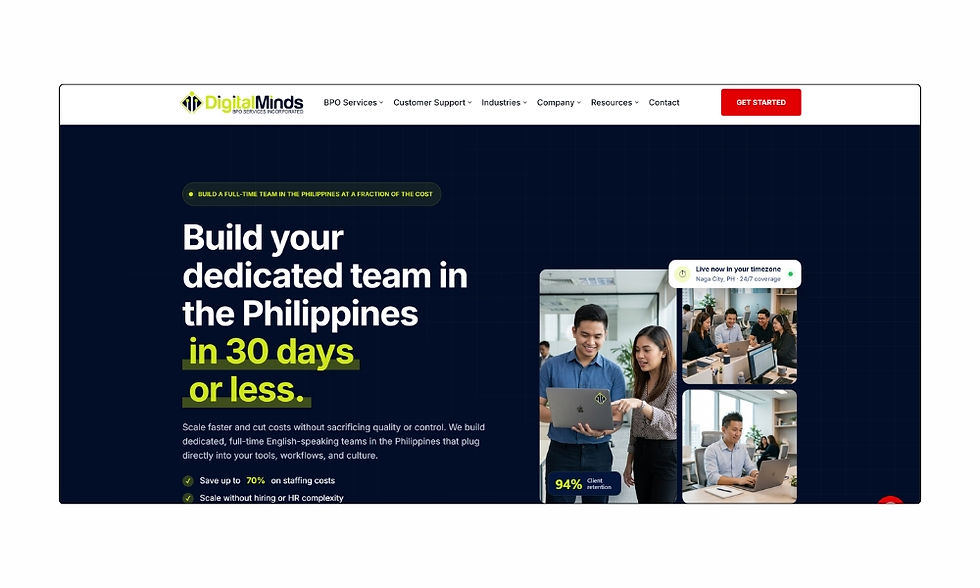
Digital Minds BPO is a Philippines-based provider with over a decade of experience in gaming customer support. It offers comprehensive full-spectrum game support, including in-game help, advanced technical troubleshooting, billing support, account queries, and expert content moderation. The company operates with GDPR, CCPA, and gaming industry security compliance in place. Its breadth makes it particularly well-suited for studios scaling from indie to mid-market that need to outsource across multiple functions without managing separate vendor relationships for each.
Specialization: Full-spectrum gaming support, in-game assistance, content moderation, billing support
Notable Strength: Affordable full-spectrum coverage with compliance certifications — strong for studios consolidating vendors
Best For: Affordable gaming BPO for publishers who need everything from player support to content moderation under one agreement
6. Teleperformance
Teleperformance is the world's largest CX outsourcing firm. For gaming companies, it delivers omnichannel player support at a scale that boutique providers cannot match — multilingual, across time zones, with a follow-the-sun staffing model that keeps queues clear regardless of geography. Its trust and safety practice supports brands managing large, active player communities. Teleperformance is the natural choice for enterprise-level gaming clients managing millions of player interactions per month who need consistent brand standards across all markets.
Specialization: High-volume omnichannel CX, trust and safety, multilingual player support
Notable Strength: Enterprise-scale infrastructure with proven multilingual coverage for global publishers
Best For: Enterprise gaming CX and global gaming support outsourcing across 20+ languages
7. SupportNinja
SupportNinja is a Philippines-headquartered BPO founded in 2015, known for its AI-driven workflows and Management-as-a-Service (MaaS) model. Rather than deploying generic scripts, it builds personalized CX playbooks for each client. For gaming companies, it offers omnichannel support, technical assistance, and content moderation with flexible team structures. The company reports a 21.4% attrition rate and high employee referral rates — indicating stronger agent stability than most BPOs of its size, which directly affects support consistency for players.
Specialization: AI-powered omnichannel support, content moderation, technical assistance, back-office operations
Notable Strength: Personalized MaaS model with lower-than-average agent attrition — stronger consistency for players
Best For: AI game support for startup gaming BPO clients that need adaptable, tech-integrated support operations
8. TaskUs
TaskUs has built its reputation as the go-to BPO for high-growth tech and gaming companies, particularly in content moderation, trust and safety, and community management. Its agents are hired for genuine gaming passion, which means player interactions feel authentic rather than transactional. TaskUs goes beyond reactive support — it actively manages community health and brand perception, making it effective for studios with large, vocal online communities who need a partner that understands the culture, not just the ticket queue.
Specialization: Content moderation, trust and safety, community management, digital customer experience
Notable Strength: Gaming-native agent culture with proactive community health management
Best For: Gaming content moderation, trust and safety BPO, and community management for gaming platforms
9. Concentrix
Concentrix is a major global CX player with deep operational presence in the Philippines. For gaming, it provides player support, outsourced gaming solutions, and analytics-driven CX management. Its strength is consistency at scale — managing high ticket volumes across multiple time zones with robust reporting dashboards that give studios clear visibility into CSAT, resolution time, and churn signals. Studios that need to demonstrate support performance to stakeholders will find Concentrix's reporting infrastructure among the most developed in the market.
Specialization: High-volume player support, analytics-driven CX, digital solutions
Notable Strength: Reporting and analytics infrastructure that connects support data to churn and retention signals
Best For: Outsourced gaming CX with analytics-driven player support for mid-to-large publishers
10. Simetrix Solutions
Simetrix Solutions is a multilingual BPO founded in 2010, headquartered in the US with operational offices across Europe — Albania, Kosovo, and the UK — and Asia. This geographic spread makes it one of the more distributed providers on this list, with genuine proximity to European and UK gaming markets. For gaming companies, Simetrix covers customer support, technical support, content moderation, data entry, and email and chat handling across the full player support lifecycle — including billing and back-office operations.
Specialization: Multilingual customer support, technical support, content moderation, email and live chat, back-office BPO
Notable Strength: European and UK market proximity with multilingual coverage and back-office depth
Best For: Multilingual gaming BPO for studios focused on European game support outsourcing

How to Choose the Right Gaming Customer Support Partner
1. Define Your Support Volume, Languages, and Non-Negotiables First
Before contacting any provider, map your baseline requirements clearly:
Estimated daily or monthly ticket volume
Required languages for your player base
Core KPIs: response time, CSAT, and first-contact resolution rate
This step prevents the most common outsourcing mistake — choosing a provider on brand recognition rather than operational fit. A studio handling 500 tickets per day in three languages needs a fundamentally different partner structure than one managing 50,000 tickets across 20 markets. Define your gaming support volume and player support KPIs before any vendor conversation begins.
2. Test Their Gaming Knowledge Before Anything Else
Gaming support requires cultural literacy — not just fast ticket resolution. An agent who has never played an MMO cannot properly triage a guild conflict ticket. An agent unfamiliar with competitive gaming culture cannot de-escalate a ranked matchmaking complaint without sounding dismissive.
Before evaluating response times or pricing, confirm prior experience with similar game genres, player communities, or brands. Request a sample scenario test or trial period. Gaming-specific expertise and gamer agents with genuine cultural fit are the first filters that separate functional support partners from the wrong fit entirely.
3. Evaluate Their AI and Tech Stack
AI chatbots can successfully resolve 45% of tier-one gaming inquiries without human intervention, and leading gaming support companies are built around this reality. Ask specifically:
What CRM and ticketing platforms do they integrate with?
Can they connect to Zendesk, Freshdesk, or your proprietary system?
Do they offer in-game support SDK integration for in-app player assistance?
Is their AI automation mature and embedded — or just a chatbot layer sitting on top of manual queues?
AI gaming support maturity is now a baseline expectation, not a premium add-on.
4. Verify Scalability — In Both Directions
A launch weekend can multiply ticket volume 10x overnight. Ask directly: What is the provider's maximum scale-up timeline? Can they add 20 agents within 48 hours?
Equally important is the other direction: can they scale down without penalty clauses when the launch window closes? Watch for minimum volume commitments and after-hours or churn penalty clauses buried in contract terms. Flexible BPO gaming models that adjust to your LiveOps calendar — not the other way around — are the standard worth holding out for.
5. Confirm Compliance Readiness
Gaming support often involves player accounts, personal information, regional rules, and sensitive escalation cases. Your support partner should understand how compliance requirements affect daily support work — from identity verification and account recovery to privacy requests, age-related restrictions, moderation decisions, and payment-related escalations.
Ask how compliance expectations are built into agent training, workflows, QA reviews, and escalation procedures. For studios serving multiple regions, make sure your partner can adapt support processes by market instead of treating every player's case the same way. Compliance should not sit outside the support operation; it should be part of how tickets are handled, reviewed, and escalated every day.
6. Assess Communication Transparency and Account Attention
Long-term gaming partnerships break down on communication quality, not service delivery. Look for a dedicated account manager — not a shared pool — with regular monthly business reviews and a documented escalation path. Boutique providers like AllyOps tend to have stronger client-to-manager ratios than large enterprise BPOs, which means faster responses when something goes wrong. Always request client references and propose a trial phase with defined success metrics before committing to a long-term contract.
7. Understand the Pricing Model and Calculate ROI Before Comparing Quotes
Typical industry pricing for gaming support in 2025–2026 runs $1,600–$2,400 per month per agent for standard player support and $2,400–$3,600 per month for technical troubleshooting agents. Content moderation or in-game support is often billed per moderation hour or by volume.
The ROI case is direct: if a studio spends $180,000 per year on in-house support for six FTEs, outsourcing at $1,250 per agent per month for six agents reduces annual cost to approximately $90,000 — a 50% reduction before factoring in reduced training, overhead, and recruitment costs. Evaluate gaming BPO pricing against that baseline, not against the cheapest hourly quote you can find.

Ready to Build a Game Support Team That Actually Gets Gaming?
Not every studio needs a BPO giant managing millions of tickets. Some need a dedicated team that knows your game, understands your community culture, and scales at your pace.
AllyOps builds dedicated game support teams around each client's exact requirements — from 24/7 ticket and in-game support to content moderation and community management. Startups and SMEs do not get deprioritized here. You get a boutique gaming BPO partner that treats your players the way your internal team would. Book a free call to find out if AllyOps is the right fit for your game.
FAQs
What is gaming customer support outsourcing?
Gaming customer support outsourcing means hiring an external team to manage player inquiries, technical issues, billing concerns, account problems, moderation, and community support. Instead of building a full internal team, studios work with specialized providers that understand game operations, player behavior, launch cycles, and support volume changes.
Why is customer support important for gaming companies?
Customer support is important because it directly affects player retention, satisfaction, and long-term revenue. The article explains that poor support can cause players to abandon a game, while positive support experiences improve retention and player loyalty. For studios, support quality can influence reviews, community sentiment, and lifetime value.
What should studios look for in a gaming support partner?
Studios should look for gaming industry experience, strong player culture knowledge, multilingual support, scalable staffing, AI-enabled workflows, data security certifications, and clear communication processes. The right partner should match the studio’s ticket volume, game genre, player base, KPIs, and launch or LiveOps support needs.
Is AllyOps a good option for gaming startups?
Yes. AllyOps is presented as a strong option for startups and SMEs that need dedicated gaming support without being treated like a small account by a large BPO. It offers 24/7 omnichannel support, content moderation, community management, and client-specific onboarding built around each game’s needs.
How much does gaming customer support outsourcing cost?
The article notes that typical gaming support pricing in 2025–2026 ranges from about $800 to $1,200 per month per agent for standard player support, and $1,200 to $1,800 for technical troubleshooting agents. Costs vary based on volume, complexity, languages, support channels, and moderation needs.

