Custom BPO Services: How Tailored Outsourcing Helps Your Business Scale

Updated: Jul 31
Custom BPO services are outsourced business operations built around a company’s exact workflows, tools, customer expectations, KPIs, and growth stage. Tailored outsourcing has moved well past cheap labour. IBM notes that business process outsourcing covers non-core back-office and front-office functions, and that companies increasingly buy access to technology and expertise they cannot build in-house. Market data reflects that shift. Grand View Research values the global BPO market at USD 328.4 billion in 2025. It projects USD 695.8 billion by 2033, a 9.9% compound annual growth rate. This guide explains what custom BPO services are and how they differ from standard packages. It also covers which processes suit the model and when a boutique BPO partner is a better fit than a large provider.
Key Takeaways
Custom BPO services adapt the workflow, staffing model, tools, quality assurance, and reporting to your operating model. Standard BPO asks you to adapt to the provider’s system.
The global BPO market reached USD 328.4 billion in 2025. Grand View Research projects USD 695.8 billion by 2033, a 9.9% annual growth rate.
Tailored outsourcing suits companies with changing workflows, seasonal demand, complex support needs, or customer contact that carries brand risk.
Evaluate providers on business fit, capability, communication model, cost structure, performance measurement, and exit plan before signing anything.
AllyOps is a boutique BPO for startups and SMEs that builds dedicated offshore teams around each client’s tools, coverage hours, KPIs, and growth plan.
What Are Custom BPO Services?
Custom BPO services are outsourced operational teams or workflows tailored to a company’s processes, systems, brand voice, service levels, reporting needs, and growth goals. The provider builds around how you already work instea d of selling a fixed package.
Business process outsourcing itself is straightforward. A company hires an external provider to run non-core functions. Back-office outsourcing covers accounting, IT services, human resources, procurement, and quality assurance. Front-office outsourcing covers customer support, sales, marketing, and technical support. Both sit under the same umbrella of process outsourcing.
Custom does not mean chaotic or built from scratch. BPO service customisation means the provider adapts six things to your operating model: the workflow, the staffing model, the tools, the QA scorecard, the reporting, and the escalation path. Everything else stays standardised so the service can scale.
The pattern shows up across industries. A SaaS startup outsources support tickets under custom SLAs. An e-commerce brand outsources order inquiries and review moderation. A game company outsources player support and community management. In each case, the custom outsourcing solution matches an existing process rather than replacing it.
Think of custom BPO as structured flexibility. The process should be standardised enough to scale and tailored enough to protect customer experience. Providers that deliver only one of the two create problems later. Pure standardisation strips out your brand voice. Pure customisation produces a service nobody can repeat or measure.

How Are Custom BPO Services Different From Standard BPO?
Comparison point | Standard BPO | Custom BPO |
Workflow design | Uses pre-set processes and vendor-defined workflows. The client usually adapts to the provider’s existing system. | Starts with workflow mapping. The provider studies the client’s current process, then builds the outsourced workflow around it. |
Staffing model | Often uses shared teams, fixed packages, or volume-based agent allocation. | Uses tailored staffing based on workload, required skills, coverage hours, language needs, and task complexity. |
Tools and systems | May require the client to use the provider’s preferred tools or standard platforms. | Works inside the client’s existing tools, such as CRM, helpdesk, email, chat, project management, or internal dashboards. |
Training and brand voice | Training is usually broad and process-focused, with limited brand-specific adaptation. | Includes client-specific onboarding, tone-of-voice guidance, product knowledge, SOPs, macros, and escalation rules. |
KPIs and reporting | Uses standard reports and common metrics, such as ticket volume, response time, or basic productivity. | Uses custom KPIs tied to the client’s goals, such as SLA compliance, QA score, CSAT, backlog reduction, resolution accuracy, or conversion support. |
Escalation process | Escalation is usually standardised and may not reflect the client’s internal decision-making process. | Escalation paths are built around the client’s team structure, risk level, approval process, and issue severity. |
Quality control | QA is often based on general service standards. | QA scorecards are customised around accuracy, tone, compliance, customer experience, and workflow-specific requirements. |
Flexibility | Best for stable, repeatable, low-complexity work with limited variation. | Better for companies with changing workflows, growth-stage needs, seasonal demand, complex support, or brand-sensitive operations. |
Best fit | Suitable when the task is simple, standardised, and cost efficiency is the main goal. | Suitable when the business needs a provider to adapt to its process, tools, customer experience, and growth model. |
The real difference is directional. Standard BPO asks the client to adapt to the vendor’s system. Custom BPO asks the vendor to adapt to the client’s operating system. Every row in the table above follows from that one distinction.
That framing also tells you which model to buy. A one-size-fits-all BPO package is enough when the task is simple, stable, and high volume. Data entry against a fixed template is a good example. Workflow customisation earns its cost when the work touches customers directly, changes often, or carries brand risk.
You can test this in the first sales call. Ask the provider to describe how they would map your current process. A custom partner opens with questions about your workflow, your tools, and your custom SLA targets. A standard provider opens with a description of theirs.
What Are the Main Benefits of Custom BPO Services?
Custom BPO services deliver five measurable business outcomes rather than a single cost saving. Each one comes from the same source: the outsourced workflow matches the way the business already runs.
Better operational efficiency: Work moves without translation because the outsourced process mirrors the internal one. Tailored solutions remove duplicate steps and shorten turnaround times.
Higher quality and accuracy: Training, QA scorecards, and best practices are built around your industry and your tasks. Agents learn your product rather than a generic script library.
More flexibility: Staffing, coverage hours, and workflows adapt as demand changes across launches, seasonal peaks, and campaign cycles.
Better customer experience: Agents follow your tone, escalation process, and service standards. Businesses that prioritise customer experience can achieve 4% to 8% higher revenue.
Stronger risk management: Compliance rules, access permissions, and process controls are built into the workflow instead of bolted on afterwards.
IBM points to a wider set of BPO benefits that apply to any model: access to innovation, around-the-clock service, improved efficiency, sharper focus on core competencies, and lower staffing and training costs. Custom outsourcing does not replace those gains. It makes them easier to capture, because the service arrives already shaped to your operating model.
Custom BPO is an operating model, not cheap labour. Deloitte’s Global Outsourcing Survey reports that skilled talent and agility now sit alongside cost reduction as key drivers for outsourcing. Buyers are paying for capability and coverage. A well-designed engagement removes repetitive work from internal teams while leaving visibility, quality control, and ownership exactly where they were.

What Business Processes Should You Consider for Custom BPO?
Start with work that is repeatable, high volume, and measurable. Four groups of processes transfer well to a custom outsourcing model.
Customer operations: Email support, ticket support, live chat, voice support, technical support, account support, refunds, and order inquiries. This is the most common entry point for outsourced customer support.
Administrative operations: Data entry outsourcing, inbox management, calendar support, document processing, CRM updates, and reporting support.
Community and brand operations: Social media moderation, community management outsourcing, content moderation outsourcing, forum monitoring, and review responses.
Specialist support: Game support outsourcing, in-game support, player support, product support, QA support, and back-office support workflows.
A simple rule keeps the split clean. Keep strategy, final policy decisions, sensitive executive decisions, the product roadmap, and legal judgment in-house. Outsource repeatable execution, high-volume support, after-hours coverage, admin load, moderation, data processing, and first-line triage. The first list defines your business. The second list runs it.
Document the process before you outsource it. A written workflow gives the provider something concrete to build against and gives you a baseline to measure against later. Custom BPO can improve a documented process and make it faster and more consistent. It cannot fix a process nobody has defined. Set aside time to map the steps, owners, and exceptions before the first agent starts, and the ramp-up period gets considerably shorter.
Learn more: Business Process You Should Outsource

What Factors Should You Consider Before Choosing Custom BPO Services?
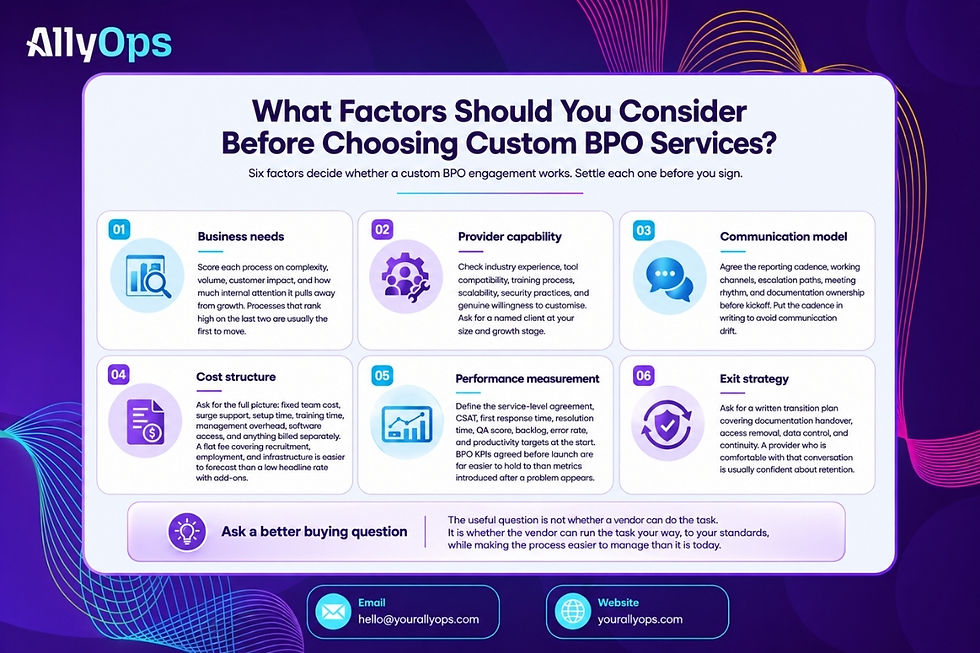
Six factors decide whether a custom BPO engagement works. Settle each one before you sign.
Business needs: Score each process on complexity, volume, customer impact, and how much internal attention it pulls away from growth. Processes that rank high on the last two are usually the first to move.
Provider capability: Check industry experience, tool compatibility, training process, scalability, security practices, and genuine willingness to customise. Ask for a named client at your size and growth stage.
Communication model: Agree the reporting cadence, working channels, escalation paths, meeting rhythm, and documentation ownership before kickoff. Partnerships weaken through communication drift more often than through service failure, so put the cadence in writing.
Cost structure: Ask for the full picture: fixed team cost, surge support, setup time, training time, management overhead, software access, and anything billed separately. A flat fee that already covers recruitment, employment, and infrastructure is easier to forecast than a low headline rate with add-ons.
Performance measurement: Define the service-level agreement, CSAT, first response time, resolution time, QA score, backlog, error rate, and productivity targets at the start. BPO KPIs agreed before launch are far easier to hold to than metrics introduced after a problem appears.
Exit strategy: Ask for a written transition plan covering documentation handover, access removal, data control, and continuity. A provider who is comfortable with that conversation is usually confident about retention.
IBM flags six risk areas worth settling in the contract itself: work quality, data security, regulatory compliance, communication barriers, over-reliance on a single vendor, and unforeseen costs. Address each one in writing during vendor selection, and the engagement stays predictable through its first year.
Ask a better buying question. The useful question is not whether a vendor can do the task. It is whether the vendor can run the task your way, to your standards, while making the process easier to manage than it is today.
When Is a Boutique BPO Partner Better Than a Large Standard Provider?
If your business needs... | Boutique BPO Partner | Large Standard BPO Provider |
Dedicated attention | Dedicated team and account management with direct access to decision-makers. | Shared account management across many clients. |
Fast implementation | Quick onboarding and hands-on setup tailored to your processes. | Longer implementation due to standardised enterprise workflows. |
Flexibility | Customisable services that adapt as your business evolves. | Fixed service models with less room for customisation. |
Communication | Close collaboration with faster feedback loops and regular strategic discussions. | More formal communication through structured account processes. |
Scalability | Can rapidly add seasonal or surge agents while maintaining a dedicated core team; reductions are managed according to agreed contract terms. | Designed for large, predictable volumes with extensive staffing capacity. |
Best suited for | Startups and SMEs that need agility, personalised support, and a long-term strategic partner. | Large enterprises with mature procurement processes, highly standardised operations, and consistently high interaction volumes. |
A boutique BPO partner fits best when you need a dedicated team, hands-on setup, and direct communication rather than a generic package. That describes most startups and SMEs.
Large providers earn their place at enterprise scale. They suit organisations with high, stable volume, mature procurement teams, and highly standardised work. Their infrastructure and staffing depth are real advantages when you are running millions of interactions a month
Why Choose AllyOps as Your Boutique BPO Partner?
AllyOps is a boutique BPO based in Cebu City, Philippines, with more than seven years of experience in business process outsourcing. It works as a seamless extension of your team, handling operational tasks behind the scenes so your internal employees can stay focused on core work. Clients include Raw Fury, DoDreams, Torn Banner, CHORD, and Hop Logistics.
Why choose AllyOps:
Services built around your workflows: Each engagement is customised to your processes rather than assembled from a fixed catalogue, making AllyOps a custom BPO service rather than a basic staffing provider.
Flexible outsourcing solutions: Services include Build Your Own Team, Virtual Assistants, Customer Support, Community Management, Content Moderation, and Game Support.
A seamless extension of your team: AllyOps manages day-to-day operational work while your internal team focuses on strategy, growth, and other high-value priorities.
Simple flat-fee pricing: One flat fee covers recruitment, employment, team management, and operational costs, making expenses easier to forecast and manage.
Responsible employment practices: AllyOps employees receive full benefits, including 13th-month pay, government-mandated contributions, paid vacation leave, and paid sick leave.
Savings without reducing employee pay: Cost savings come from avoiding recruitment, onboarding, management, and infrastructure overhead, not from underpaying the people doing the work.
Proven BPO experience: With more than seven years in the industry, AllyOps supports established companies across gaming, logistics, technology, and other sectors.
FAQs
What are custom BPO services?
Custom BPO services are outsourced business operations built around a company’s own workflows, tools, brand voice, service levels, reporting needs, and growth stage. Instead of buying a fixed package, the client keeps its process, and the provider adapts staffing, quality assurance, escalation rules, and reporting to match it.
How do custom BPO services differ from standard BPO?
Standard BPO runs on vendor-defined workflows, shared teams, and generic reports, so the client adapts to the provider’s system. Custom BPO starts with workflow mapping and builds staffing, tools, training, KPIs, and escalation paths around the client. Standard suits simple, stable, high-volume tasks. Custom suits complex or brand-sensitive work.
Which business processes work best for custom BPO?
Customer operations such as email, chat, voice, and technical support are the most common starting points. Administrative work including data entry, inbox management, and CRM updates also transfers well. So do community management, content moderation, and specialist areas like game and player support. Strategy, product roadmap, and legal judgment should stay in-house.
How much do custom BPO services cost?
Pricing varies by model. Common structures include a fixed monthly fee per dedicated agent, hourly rates, per-ticket pricing, and monthly retainers. Compare the full cost, including setup, training, management overhead, software access, and surge support. A flat fee that covers recruitment, employment, and infrastructure is usually easier to forecast than a low base rate with add-ons.
Are custom BPO services suitable for startups and small businesses?
Yes. Startups and SMEs often benefit most, because they need a dedicated offshore team without enterprise minimums or long procurement cycles. A boutique BPO partner can build the workflow around existing tools and coverage hours. The model suits companies that have outgrown freelancers but are not ready for a rigid enterprise contract.